In this recording will cover the installation and Quick start launch of Aria Automation 8.16 using VMware Aria Suite Easy Installer.
The following steps need to complete before start installation. 1. Download the VMware Aria Automation lifecycle installer ISO 2. Pre-stage the DNS records for the following instances: a. VMware Aria Suite Lifecycle aka vRLCM b. VMware Identity Manager aka (vIDM) c. VMware Aria Automation aka (vRA) Note: This is lab environment I have installed standalone instance of vIDM and vRA for the Production deployment you must deploy the cluster instances which required the external load balancer.
Part-2, VCF DSM 2.1.1, In this recording will cover the Installation and Basic configuration of DSM 2.1.1 Release.
The following steps are covered in this video: 1. Instatllion of DSM appliance using vCenter UI 2. DSM vCenter client plugin registration 3. Creation of DSM IT Policy using vCetner console (IT Policy, IP Pools, VM Class) 4. DSM User Permission and DSM Local user account creations (DSM Admin and DSM users account) 5. Active Directory Service integration with DSM (Import AD trusted root certificate) 6. Active Directory User Groups settings 7. Verification of DSM RBAC using both DSM users and AD users accounts. 8. Enable Data Services templates for MySQL and Postgres 9. Create or Provision PostgreSQL standalone instance 10. Connect to Postgres database instance using pgAdmin.
VCF DSM or VMware Data Service Manager 2.1 and 2.1.1 release includes the following new features and improvements.
Easy installation process: DSM 2.1 Installer OVA is bundled with database templates. These templates remove the requirement of S3 object storage for DSM installation. However, S3 Object Storage is still required for backups and logs.
DSM 2.1 improved alerting for easy troubleshooting
Improved Certificate Management
Notable Database management improvements: MySQL now supports stand-alone and 3 Nodes Cluster Deployments, LDAP Authentication for Databases.
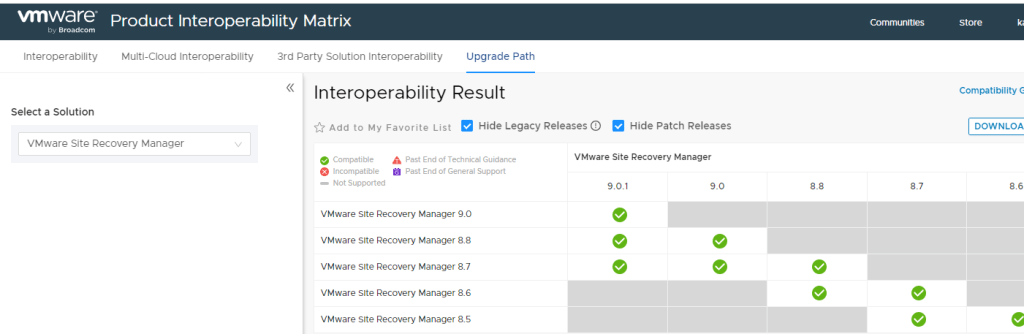
In this blog post, I would like to share the recent SRM 8.7 to 9.0.2 Upgrade experience. VMware Site Recovery Manager Upgrade from 8.7 to 9.0.1. the SRM upgrade completed successfully but the SRM client plug-in for vCenter shows in failed status.
We raised the GSS support case. We understand from the support Engineer that this issue has been reported as known issues with SRM 9.01 version when you have vCenter 7.0.3 environment. Reference: KB No. 372690.
The above KB mentioned that SRM & VRMS 9.0.1 plug-in is not compatible with vCenter 7.0.3 but works fine with vCenter 8.0.2. Note: SRM functionalities are not affected. The only issue is that users can’t launch the SRM UI from vCenter Server. Nevertheless, the admin user can access the SRM UI directly by accessing SRM or VRMS URLs at https://srmfqdn/dr or https://vrmsfqdn/dr.
GSS suggested the proposed feasible options: 1. Upgrade the vCenter Version from 7.0.3x to 8.0.2 2. Upgrade the SRM version from 8.7 to SRM 9.0 3. Upgrade the SRM version from 8.7 to SRM 9.0.2 4. Upgrade the SRM version 9.0.1 to 9.0.2 5. Use the interim fix, to access SRM UI you will need to access it via the link at https://srmfqdn/dr or https://vrmsfqdn/dr
In our case, we can’t select Choice No.1. It is a production environment. It requires another CR to upgrade the vCenter version. We have opted for the choice nos. 4. Upgrade the SRM version 9.0.1 to 9.0.2 which is a suitable resolution. Choice No. 4 also we have encountered the issues that “Operation Failed”, Failed to install update: Unknown error 243.
We have referred to this KB Nos.372249 and installed this patch ‘dr-configurator-9.0.1-76796489.x86_64.rpm‘ to resolve the upgrade installation issue. After installing the patch as per the steps mentioned in the KB372249. The SRM Upgrade from 9.0.1 to 9.0.2 completed successfully.
Another caveats is the VMware upgrade path does not shows the SRM 9.0.2 since the product name has been changed as VMware Live Site Recovery (VLSR). VMWare Site Recovery Manager Upgrade Path:
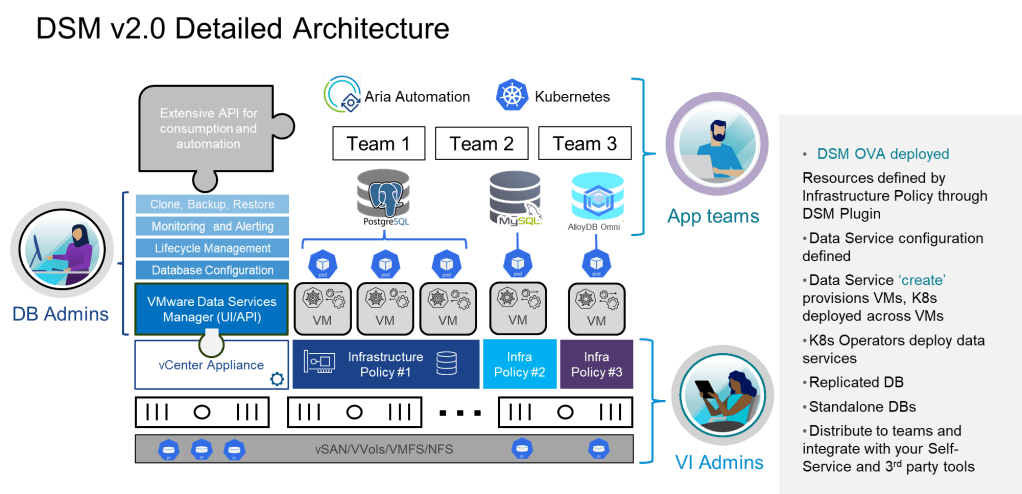
VMware released new version of DSM 2.0.3 on 6th May 2024, there is architectural changes in this release compare to previous version 1.x. detailed changes refer the VMware Data Service Manager release notes 2.0.
VMware Data Service Manager provides modern database and data services management for VMware vSphere. DSM Provides a data-as-a-service (DaaS) toolset for on-demand provisioning and automated management of PostgreSQL, MySQL databases in vSphere/VCF environment.
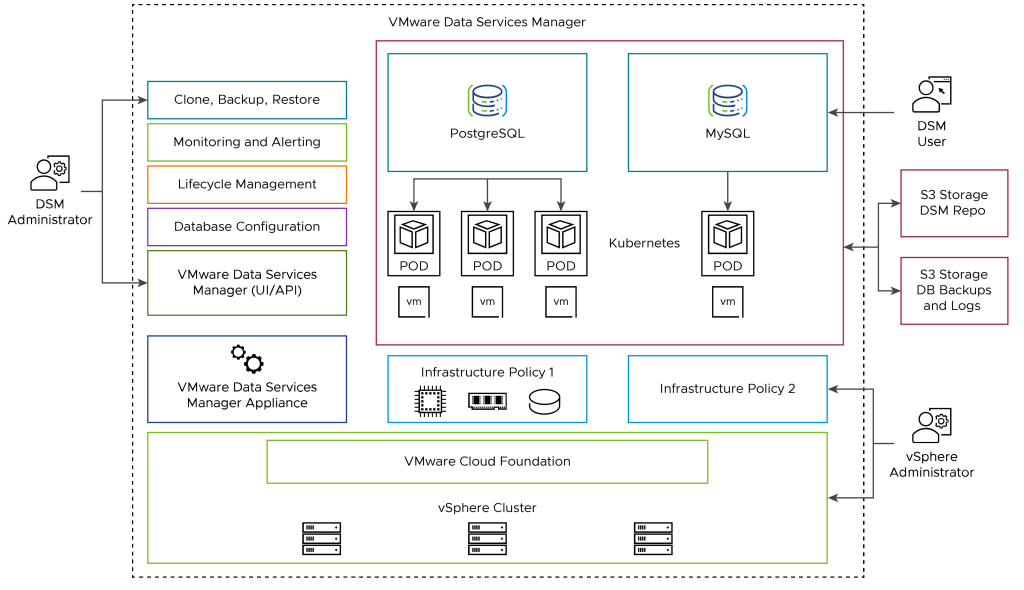
VMware Data Service Manager Appliance – An Virtual appliance deployed in the vSphere Data Center, Machine, it is also called DSM Provider VM.
Infrastructure Policy – Defines the Compute, Storage and network resources for the database to be deployed.
DSM Console – User Interface that DSM Administrator and Users can access to create database or data services and perform the life cycle management operations of the data services.
Database VM – An Ubuntu virtual machine that hosts a data service created by a Data service Manager User. VMWare DSM2.0 currently supports Provisioning of MySQL, PostgreSQL databases.
Database Topology – the DSM user can specify database topology. Depending on the topology, the database can be replicated (Clustered) or standalone.
VMWare Data Service Manager User Roles: There are Three type of Primary user roles in DSM 2.0
AvSphere administrator deploys and monitors VMware Data Services Manager Appliance, plans, administers, and secures resources for databases by creating and managing infrastructure policies, and monitors database VMs.
A DSM administrator performs tasks that include managing VMware Data Services Manager settings and users, changing database ownership, and so on.
A user in the DSM user role typically provisions and manages databases and performs database lifecycle operations. Refer the VMware document to understand the detailed DSM 2.0 User roles and responsibilities.
The previous post (Part-3). I have covered installation of Horizon 8 Replica Server, in this section (Part-4) I will go through the Initial configurations of Horizon 8.
Horizon 8 Initial Configurations
Before starting the Configurations make sure the following prerequisites are in place.
Domain User account assigned with required privileges for instant clones, this user account should have rights to joining the Instant clone Virtual Machines to the Active Directory Domain.
Note: In this lab setup I am using the single domain user account which is assigned the vCenter Server Integration and Instant Clone admin privileges, for the production deployment refer the VMware documentations.
Look at the below video to understand the configurations.
In the upcoming post (Part-5) I will cover the Horizon’s Events Database Configuration.
In the previous post (Part -2) Covered the installatoin of Horizon 8 Connection (Standard) Server, in this section (Part 3) I will cover installation of Horizon 8 Replica Server.
Horizon Replica Server Overview:
Horizon Connection Server first installation instance is called Standard Server, to have high availability and load balancing we need to have more than a connection server in a pod, we can have maximum of 7 connection servers in a single pod.
Horizon Replica server Hardware system requirements same as Horizon Connection server, the only requirement is, you must install the replica server instance in the same physical location (data Center) of the connection Server instance installed. in case your requirement to deploy Horizon 8 span across multiple data Center it is recommended to make use of the Cloud Pod Architecture feature.
Watch the below video to understand Horizon 8 Replica server installation steps.
In the previous post (Part -1) I have covered the high level Horizon 8 architecture and core components specifications, in this section (Part – 2) I will cover installation of Horizon 8 Connection Server.
Horizon 8 Connection Server Prerequesites.
Before starting the installation of first connection server (Standard Server) make sure that required prerequisites are in place. Such as supported version of Active Directory, Service accounts, Static IPs, network ports are open, Horizon Installer, Licenses etc.





 SK ITPro